Legacy, Take Two
How a visit home inspired new reflection

A recent trip back East to where I grew up got me thinking about my paternal grandfather, Dennis. It started as I left the family cemetery with dirt-covered hands.
My last Substack was about my maternal grandfather, Keith - an MIT graduate, lieutenant colonel under General MacArthur, and war hero. Many of those who read it offered kind words about him and the legacy he has left. I was grateful to be able to share him with the world (or, at least, people who read my posts!).
In some ways, I felt that I knew more about Dennis than Keith until recently. What I started to realize in that cemetery far away is that, like with Keith, there was more to put together. And when I did I discovered that while they could not seem more different, their commonality (beyond a shared granddaughter they never knew) explains generational grief that has landed with me.
Dennis’ life began in Ireland in the late 1800s. Yes, you read that right. My grandparents were born not in the last century, but the one before. They had children at a relatively advanced age for their time, and my father did not marry until his 50s. I never met either of my grandparents, and my dad died when I was a child not having told much if anything about his parents that I could recall.
I knew most of the life statistics on Dennis - his birth, marriage, parental status, death - having gathered them in support of attaining Irish citizenship many years ago. What I had never really contemplated until my recent visit back home was his full story.
An Irish census from 1901 reveals some fascinating facts. I was told about this record on a visit to County Cork to visit family about 10 years ago and pulled it up online:
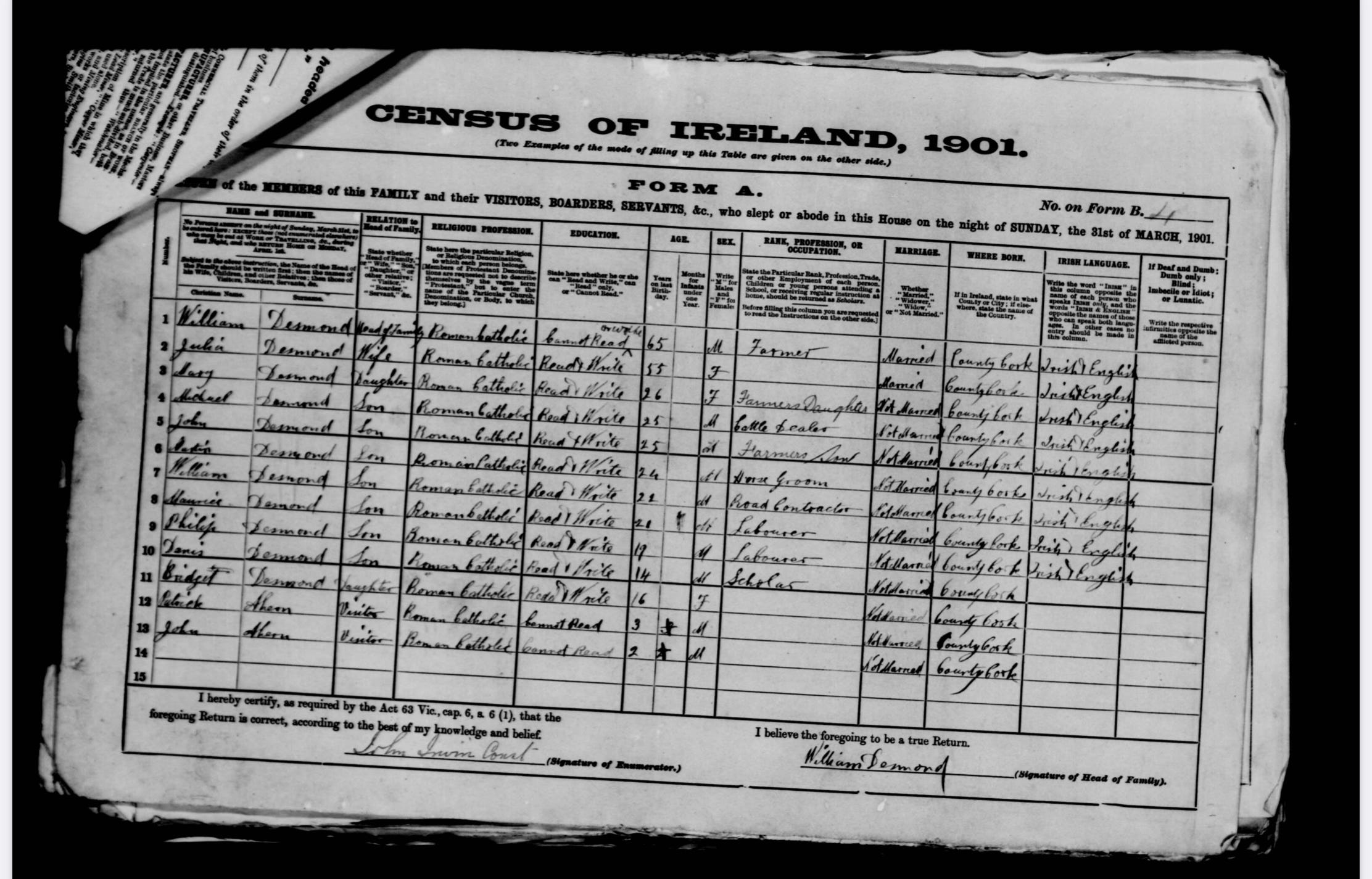
The head of household, my great-grandfather, was an illiterate farmer (but somehow in possession of a perfect signature to validate the document….). He was 65 at the time
Everyone else in the house, except the two toddlers that seem to have been taken in, can read. These toddlers bear the last name of relatives I vaguely recall from growing up, but otherwise I am not sure of the story. My great-grandmother, literate, was raising two little ones at the age of 55 after having at least the 9 children listed as living in the home
My grandfather was the youngest child, listed as “scholar” - likely meaning just a school boy. The occupations of his siblings range from “farmer’s daughter” to “farmer’s son” to “horse groom” and “road contractor” and “labourer” - we’ll see road contractor/labourer again in this story
They all speak both Irish and English
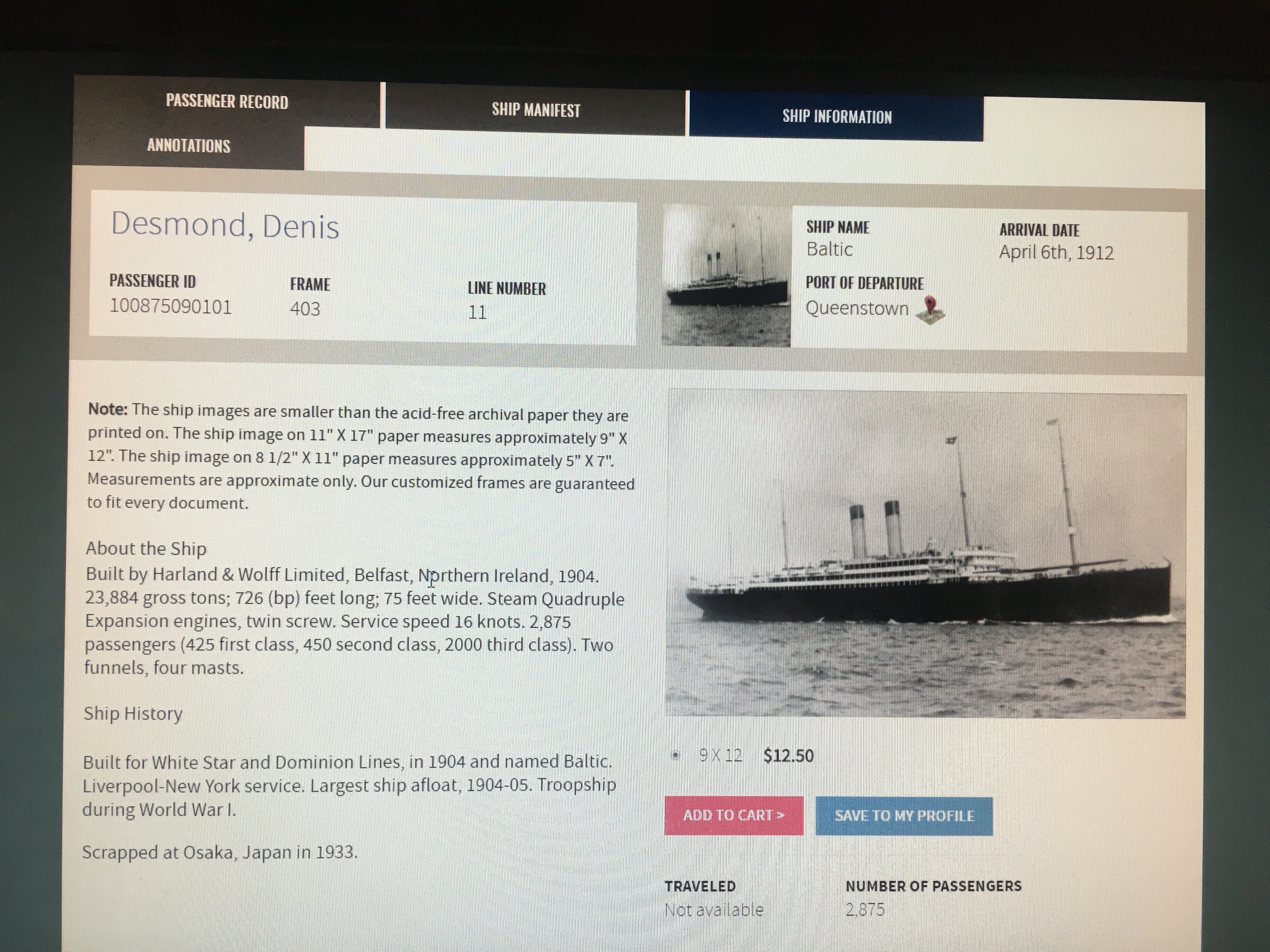
In 1912, Dennis sailed to America. This I know from visiting Queenstown (now Cobh) in 2018 and pulling up his passenger information. This information is housed at the Titanic Museum. Queenstown was the last point of departure for ships to America, including the Titanic. Dennis took the ship that left right before the Titanic. So, essentially one week or so later and he would have been Leonardo DiCaprio’s character (probably minus the romance with Rose).
The rest of Dennis’ history I knew vaguely. He married Hannah (who grew up near him but came to America a year later) and had a baby boy who died. The boy was named after Dennis’ father, William, as every boy in the family was to be named. So, when my dad was born he was given the same name. His younger brother followed a few years later.
Here is where the new reflection comes in. I knew from other census records that Dennis had been a bartender. I also knew that he had died working as a laborer building streets. I didn’t give this much thought until I went to visit the family plot.
My grandmother purchased a number of spots in the Catholic cemetery in 1931. My parents are there, my stepfather as well (lots of unused spots, seriously). I showed up on a Tuesday morning to check on things. My last visit was a very quick one 5 years ago to bring my mother’s cremated remains. We had last been there 10 years before that with my stepfather’s. I knew my grandparents and uncle were there, but had never noticed the other graves. One, a man who died in 1931, seems to have been my grandmother’s brother. His death must have been the impetus for the purchase. The other, Mary, appears to be Dennis’ oldest sister (the farmer’s daughter of the census) - unmarried at age 26 in 1901 but made it to America and died with a married name. My grandmother purchased lots of spots likely because in 1931 she had two young boys and must have assumed she’d get lots of grandchildren. She got one, and never knew it. The younger boy became a priest (a huge source of pride back in Ireland, as I discovered when I saw his a picture from when he was ordained hanging in the kitchen of the farmhouse where that census was captured).
My grandmother also paid for “perpetual care” at this cemetery, meaning the gravestones should be groomed regularly. My father inadvertently paid for it again. I was told more than once by mom, remember that’s has been paid TWICE and don’t pay it again. What I can tell you is that each of the very few times I have gone to the cemetery, those gravestones are completely covered up. But it was in the unearthing, knees in wet grass, hands pulling overgrowth to reveal names and dates, that this story started to come together for me.
My grandfather died in his late 40s in 1935. His age and the dates and his employment history got me thinking. When he arrived in America, he was a bartender. When he died he was a laborer. What happened? Prohibition. The Depression. A young man’s profession disappears, he has kids, what is he to do but find work in any way he can? He dies at work, of “sunstroke” - which I have to assume had to do with his heart. The hearts of men in my family are notoriously bad. Heart disease took my dad. Dennis, like Keith my war hero grandfather, died at work due to his heart. Like Keith, he left a child not yet an adult, who became a parent to me.
The Irish are incredibly proud of their contributions to building America. My family in Cork regaled me with the tale of a relative who died building streets in America. They didn’t know his name, but of course that was Dennis. I said, yes - I know, my grandfather! They didn’t know his name, but they knew his legacy.
I had occasion on this trip to also visit the Tenement Museum on the Lower East Side of Manhattan. They profiled an Irish immigrant family from the 1860s on the tour I took. Very different time from my grandparents’ arrival, but the themes are similar. Loss, hardship, exclusion, grief. I could see all of this in Dennis. This aspect of my history is in sharp contrast to that of my maternal lineage, pre-dating the Mayflower. But it’s no less important.
Which leads me back to legacy. I don’t have pictures of Dennis, unlike Keith in his highly decorated uniform, riding with General MacArthur and building war-winning infrastructure. What I have is his story, my connection to another land where the roots run deep, and a growing understanding of the history that waits, sometimes just beyond our immediate reach, that has affected our lives in ways we might never realize.
As I left the cemetery, I went into the office to ask about the maintenance. I was told they’d get on it and let me know in a couple of weeks. I asked how we could make sure it gets done regularly. There’s no one else to check on it, and I am rarely there. They told me to call every year. I then showed them my hands, covered in the grass and dirt of my family’s resting place and asked if I could wash them. Nope, no public restroom. No apologies. And so, off I went with my hands covered by the evidence of unearthing history and piecing together Dennis’ story as I continue to go along. And realizing that my work in legacy is tied to each of the grandfathers who died doing their work.
And so, just like Keith, Dennis Desmond is now on the Internet and part of my digital legacy.